Here's an informal summary of the projects I've worked on...
PhD Research (2017-present) - How do ants do?
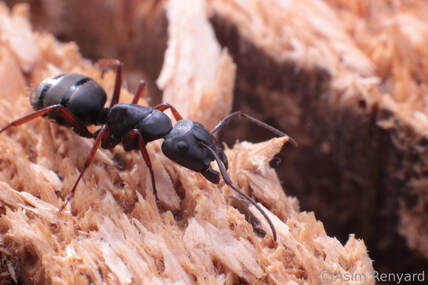
In 2016, an undergraduate summer project on Carpenter Ants turned into Master's project which then turned into PhD project. My PhD thesis, titled "Foraging and Communication Ecology of Carpenter Ants" is essentially a bunch of ideas I think are cool and then stapled together under a very broad title to call a thesis. Ants often work together to accomplish tasks and my thesis focusses on understanding what information ants use to make decisions and how they communicate that information to each other to coordinate group tasks. The focal species for my research, the Western Carpenter Ant (WCA; Camponotus modoc) is a forest-dwelling ant species on the West coast of North America.
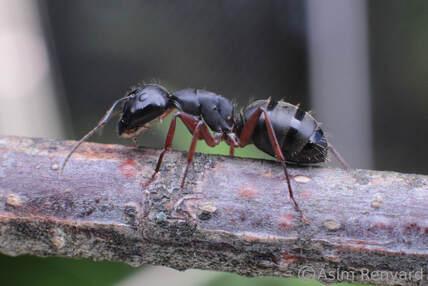
Follow Your Nose - The Use of Olfactory Cues During Foraging in WCAs
Ever wonder how ants find their food? Me too. Carpenter ants travel enormous distances to find food - up to 200m! To put that in perspective that is equivalent to a human walking 37 km for their next meal. So, how can an ant locate a food source in such a huge area? Randomly searching around seems inefficient and finding things visually seems unlikely as WCAs have poor vision and forage nocturnally. Smell, however, has a lot of potential for ants, smell lingers and leaves odour plumes that the ants can follow! By running olfactometer trials, (aka a smell test) we sample the ants "opinions" to see which food smells are attractive to the ants. Stay tuned for more on this!
Ever wonder how ants find their food? Me too. Carpenter ants travel enormous distances to find food - up to 200m! To put that in perspective that is equivalent to a human walking 37 km for their next meal. So, how can an ant locate a food source in such a huge area? Randomly searching around seems inefficient and finding things visually seems unlikely as WCAs have poor vision and forage nocturnally. Smell, however, has a lot of potential for ants, smell lingers and leaves odour plumes that the ants can follow! By running olfactometer trials, (aka a smell test) we sample the ants "opinions" to see which food smells are attractive to the ants. Stay tuned for more on this!
Where do you want to eat? - Resource evaluation in WCAs
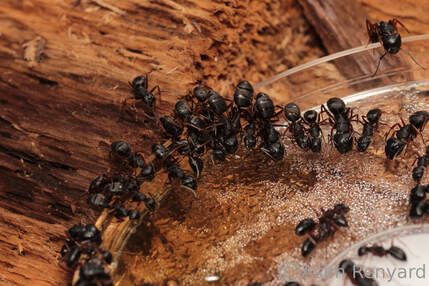
The age old question of deciding where to eat. Once at a food resource the ant has another decision to make, is this resource worth exploiting by my colony? Ants work together to monopolize food resources. But, there are a number of considerations, is there enough food here? Can we forage efficiently on this resource (i.e. is it difficult to access? is it hard to feed on?)? Is it nutritionally valuable for our nest? We have been examining these questions, and you will hopefully see some of this work soon!
The age old question of deciding where to eat. Once at a food resource the ant has another decision to make, is this resource worth exploiting by my colony? Ants work together to monopolize food resources. But, there are a number of considerations, is there enough food here? Can we forage efficiently on this resource (i.e. is it difficult to access? is it hard to feed on?)? Is it nutritionally valuable for our nest? We have been examining these questions, and you will hopefully see some of this work soon!
Trail pheromone Identification in WCAs
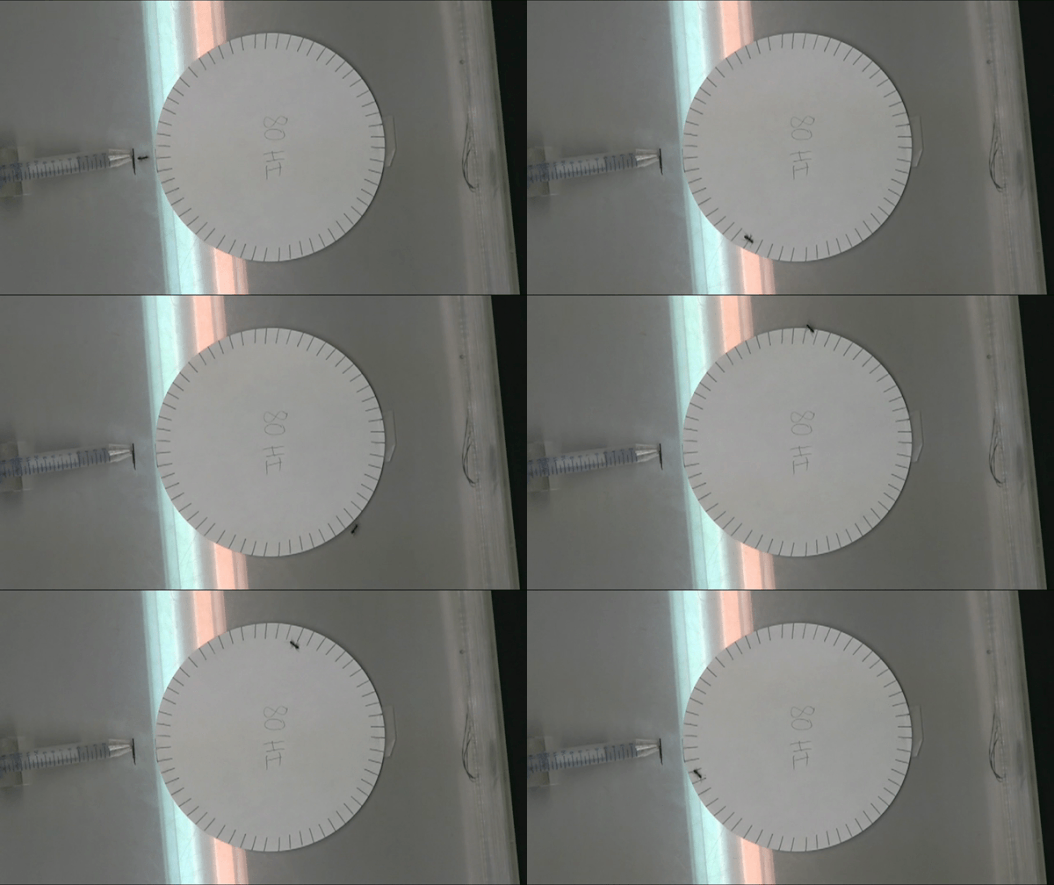
You may scold your dog for dragging its butt across the carpet but for ants this type of behaviour is celebrated! Let me explain. Once an ant has decided that a resource is worth exploiting, she must communicate the location of the resource to her nest mates. WCAs do this by dragging their butts along the ground while releasing trail pheromone. This chemical trail guides her nest mates to the food resource and gives rise to those characteristic ant highways you've seen in nature documentaries! By measuring the distance followed on a circular trail, we identified the glandular source of the pheromone and the pheromone molecule that mediates trail following behaviour. Moreover, we uncovered an uncommon dual function of the pheromone where it also attracts ants over a distance (read the paper here)!
You may scold your dog for dragging its butt across the carpet but for ants this type of behaviour is celebrated! Let me explain. Once an ant has decided that a resource is worth exploiting, she must communicate the location of the resource to her nest mates. WCAs do this by dragging their butts along the ground while releasing trail pheromone. This chemical trail guides her nest mates to the food resource and gives rise to those characteristic ant highways you've seen in nature documentaries! By measuring the distance followed on a circular trail, we identified the glandular source of the pheromone and the pheromone molecule that mediates trail following behaviour. Moreover, we uncovered an uncommon dual function of the pheromone where it also attracts ants over a distance (read the paper here)!
Strength in Numbers - Alarm Pheromone Communication in WCAs
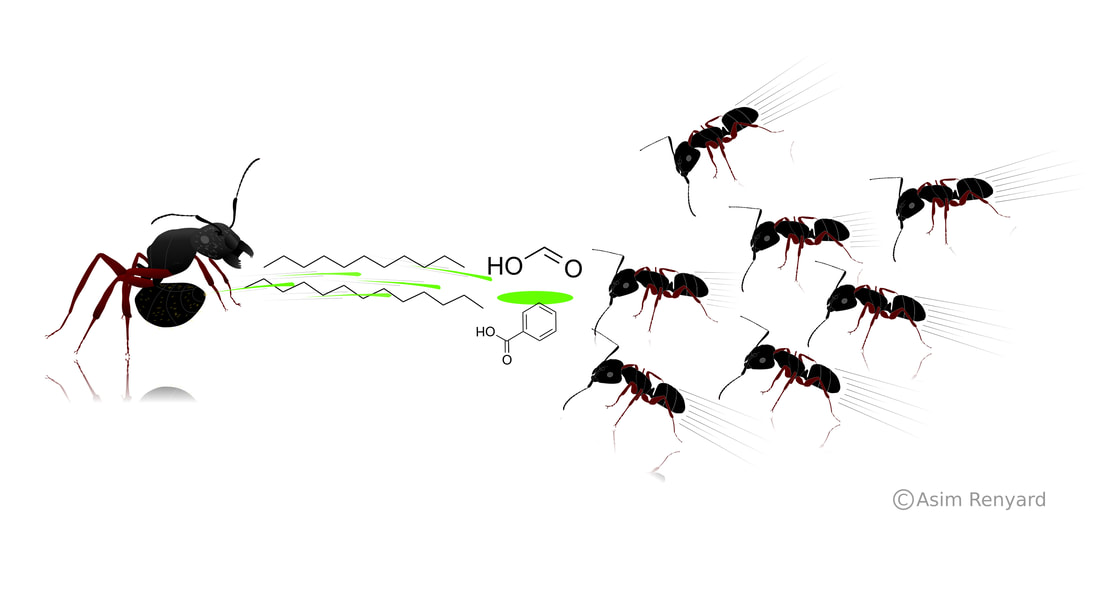
When threatened, many ants discharge both chemical defence chemicals and alarm pheromones to subdue enemies and alert nest mates. WCAs often spray from their abdomen when distressed (kind of like a skunk), however there has been little investigation on the behavioural function of these sprays. Here, we used modern analytical chemistry techniques and olfactometer bioassays to identify a blend of acids and hydrocarbons that mediates recruitment of nest mates (find the paper here)!
When threatened, many ants discharge both chemical defence chemicals and alarm pheromones to subdue enemies and alert nest mates. WCAs often spray from their abdomen when distressed (kind of like a skunk), however there has been little investigation on the behavioural function of these sprays. Here, we used modern analytical chemistry techniques and olfactometer bioassays to identify a blend of acids and hydrocarbons that mediates recruitment of nest mates (find the paper here)!
Good Vibrations - Vibrational Communication in WCAs
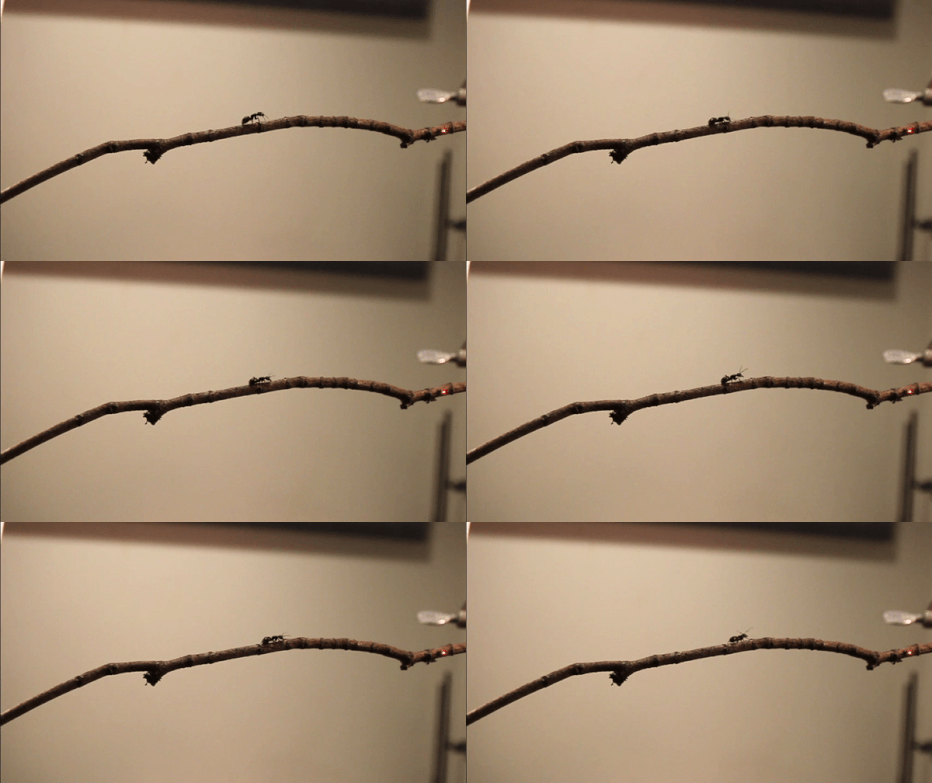
Substrate-borne vibrational signals are another commonly used communication modality in ants. Yet, vibrational signals have received far less attention in comparison to pheromones. In addition to spraying pheromone when distressed, WCAs also do this characteristic drumming where they whack their bodies against the ground! Our work here focusses on characterizing this signal and behavioural changes it causes in conspecifics. By using a combination of modern vibration recording tools we hope to shed light on this communication signal in WCAs!
Substrate-borne vibrational signals are another commonly used communication modality in ants. Yet, vibrational signals have received far less attention in comparison to pheromones. In addition to spraying pheromone when distressed, WCAs also do this characteristic drumming where they whack their bodies against the ground! Our work here focusses on characterizing this signal and behavioural changes it causes in conspecifics. By using a combination of modern vibration recording tools we hope to shed light on this communication signal in WCAs!
Collaborative project (2018-2019) - Eavesdropping ants
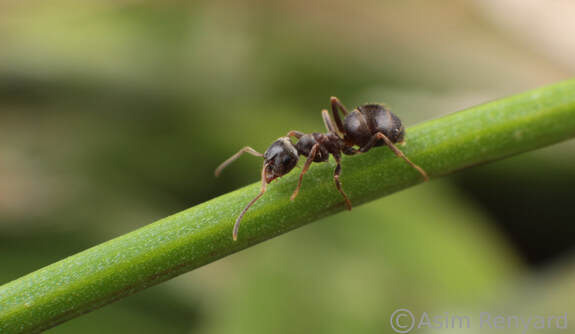
Do ants eavesdrop on each others pheromones? In this study, led by my pal Jaime Chalissery, we examined if ant community members can sense and follow each other's trail pheromones. Trail pheromones, which ants use to guide nest mates to food resources, are persistent in the environment. Through a combination of electrophysiological recordings and trail-following behavioural bioassays we determined that yes, ants do indeed eavesdrop on each other's pheromones (read the paper here)!
Undergraduate Research (2015) - Skunk Cabbage, Rove Beetles, and the Poo Smell
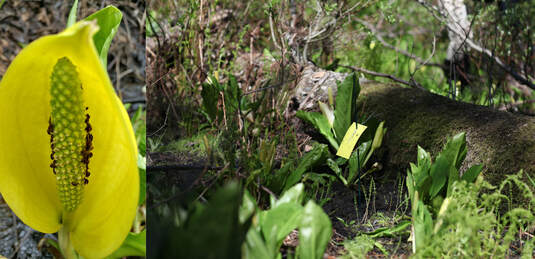
This was my first real field project and little did I know it would have me scrambling around in the mud, setting up insect traps, and smelling the poo smell on a regular basis. Confused? Perhaps a bit of background will help. When we think of pollinators our minds typically jump to bees (which is fair, bees do a lot of pollination) but other insects also pollinate! Flies, beetles, even mosquitoes can act as pollinators! In swampy places in BC, Western Skunk Cabbage (Lysichiton americanus) is one of the first plants to bloom in spring. My mentor, then PhD student, Dr. Bekka Brodie, and I examined if the "skunky" odour produced by the plants attracted their primary pollinator the rove beetle, Pelecomalium testaceum. By taking electrophysiological recordings in the beetle's antenna, we found three chemicals consistently elicited responses in beetle antenna, two hydrocarbons and indole (aka the poo smell). We then set out these yellow sticky card traps paired with a small vial of synthetic versions of each of these chemicals mounted on a bamboo stake in swamps filled with skunk cabbage and beetles. We found that indole alone caught more beetles than the hydrocarbons or a blend of all three chemicals, indicating that it is the primary attractant for the beetles (see the paper here)!
